Integrate in hours, not months.
Point your existing OMS/EMS at Meridian over the order-entry and market-data protocols every institutional desk already runs — the industry standard, so integration is hours, not months. No new tooling, no web3 learning curve.
Institutional flow doesn't hit a matching engine directly — it arrives through an accountable broker. NYSE and NASDAQ have worked that way for decades. Meridian ports the pattern to Sui.
A wallet is not a session-based counterparty. A session assumes a provisioned, limit-bounded member firm — that's what the broker tier gives it to bind to.
Matching integrity
Deterministic matching designed for TEE attestation — so validators can refuse to settle from an unattested engine.
Accountable access
Every order is broker-signed and strictly sequenced — who submitted what, in what order, and who is liable, is always attributable.
Verifiability
Custody and a signed checkpoint live on Sui — anyone can audit the canonical state (how).
Each layer is bounded by hardware, by liability, or by the public chain — not by a promise.
Broker-signed. Signed with the broker's registered key; verified against its on-chain public key.
Strictly sequenced. A per-broker sequence number (a nonce) — replay-proof, deterministic.
Bounded. Per-broker notional caps enforced at intake — exposure is always bounded.
KYC at the boundary. Identity and the regulated relationship live at the broker — like a member firm. The venue stays an infrastructure primitive.
Not a diagram — and already more than one.
More than one broker already runs on the venue — each a different product, each on the same unchanged engine and settlement. Two surfaces that share nothing but the rails beneath them.
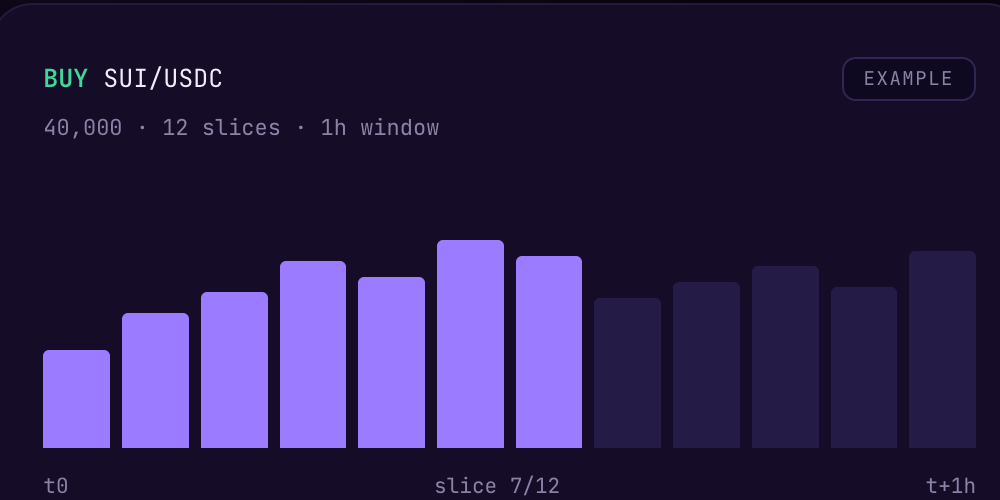
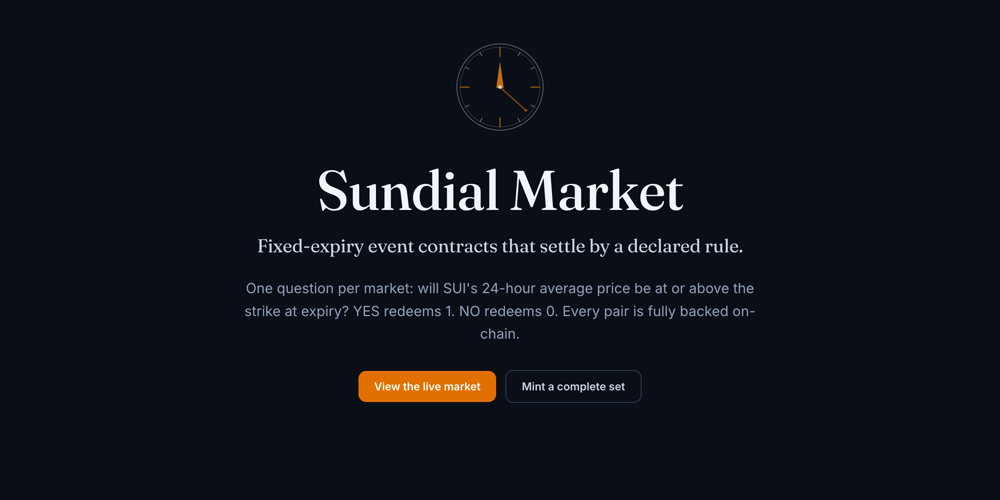
Two products that agree on nothing but the venue beneath them — the proof the tier generalizes. Independent third-party brokers — your own identity, stake and KYC, with the venue never seeing your flow — are the next tier.
Cached snapshots
Ticker, top-of-book, recent trades — edge-cached REST that serves any number of pollers without touching the engine.
Gated stream
Per-symbol order-book and trade streams for integrators and algo desks — every tick, behind provisioned access.
Dedicated feed
The engine's native binary feed, dedicated, for co-located traders — a later tier.
One principle underneath all three: public consumers never touch the matching engine. The engine publishes once; a separate distribution layer fans out.